Relevant Terminology
MoBI: wireless mobile brain-imaging
fMRI: functional magnetic resonance imaging
Meeting of Minds (2024-current)
Partners: NobleMotion Dance, Musiqa, multimedia artist Badie Khaleghian, The University of Houston BRAIN Center directed by Jose-Luis Contreras-Vidal
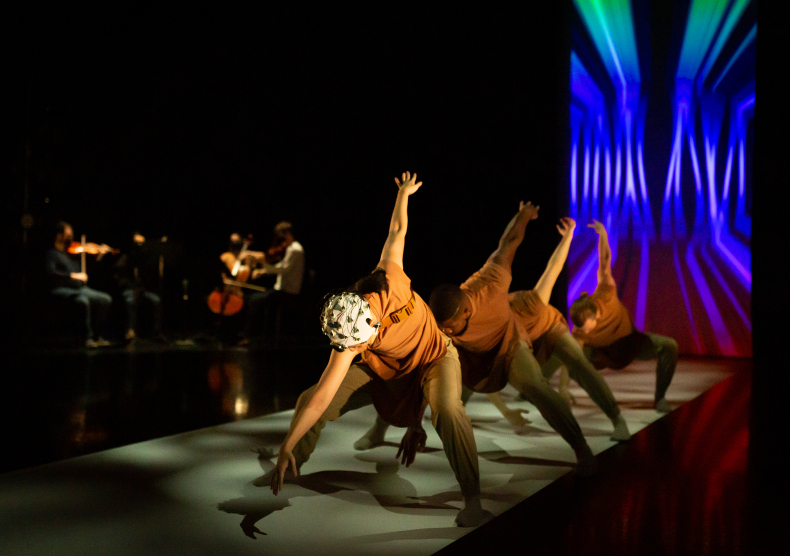
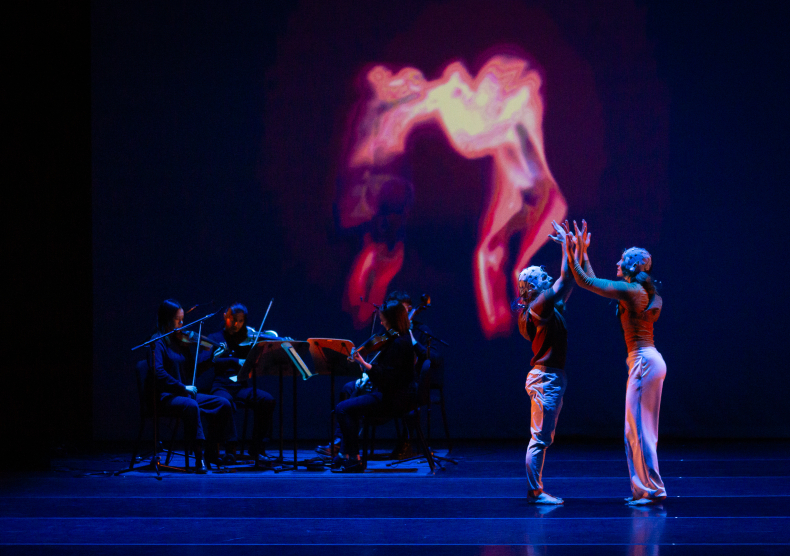
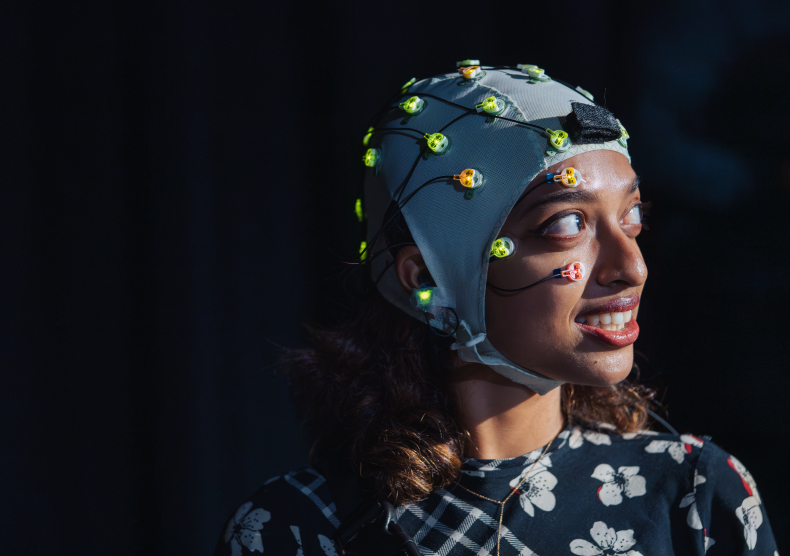
The Experiment: Two dancers wore MoBI equipment as they rehearsed and performed a dance about the building of social connection, with music by Anthony Brandt and choreography by Andy and Dionne Noble. In the course of the thirty-five-minute dance, the dancers evolved from conflict to cooperation. The score was written for live and pre-recorded string quartet, with the pre-recorded tracks ensuring that all the performances were precisely aligned for scientific study. Badie Khaleghian designed a brain synchrony meter displaying real-time visualizations of the data: the brighter the meter, the greater the neural alignment between the dancers’ brains.
Key Findings: When the dancers first rehearsed the dance, the neural synchrony between the dancers remained high in both the conflict and cooperative sections, with the brain synchrony meter showing little change. This was because, even when they were supposed to be at odds, the dancers were vigilant about accidentally striking one another. However, as they mastered the choreography, the dancers became more confident about ignoring each other during the conflict sections. Then, in later sections devoted to eye contact, touch and synchronized movement—all key indicators of cooperation—their brains became more aligned. As a result, in performance, the synchrony meter gradually evolved from dim to bright.
Diabelli 200 (2023-current)
Partners: Musiqa, multimedia artist Badie Khaleghian, The University of Houston BRAIN Center directed by Jose-Luis Contreras-Vidal
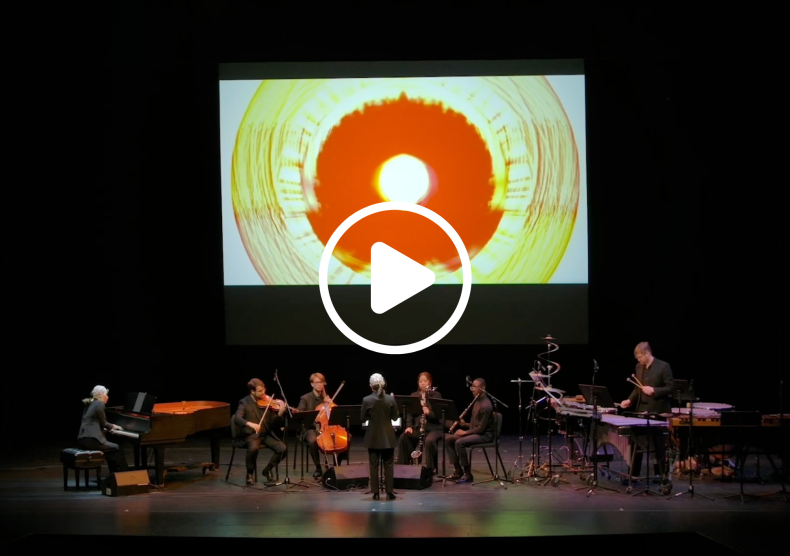
The Experiment: The pianist and conductor wore MoBI equipment while performing a new chamber ensemble work by Anthony Brandt inspired by Beethoven’s Diabelli Variations. Badie Khaleghian designed projections that were influenced by the neural synchrony between the two performers.
Key Findings: The researchers found areas of the brain that were aligned between the pianist and conductor, but also areas that were operating independently—a reflection of their different roles in the performance. A follow-up study is looking at the cues for tempo changes as particularly salient moments of neural coordination.
Balinese Gamelan, Mind, Brain and Body (2024-current)
Partners: Rice University’s Medical Humanities Research Institute, The University of Houston BRAIN Center directed by Jose-Luis Contreras-Vidal, multimedia artist Badie Khaleghian, Elkhonon Goldberg, Cokorda Bagus Lesmana, Made Indra Sadguna, Made Ayu Desiari, Udayana University, The Art Institute Denpasar, TEC de Monterrey
The Experiment: This was the first MoBI study of gamelan music and dance conducted in Bali, Indonesia. Pairs of performers wore MoBI equipment while rehearsing and performing a new gamelan work with music by Made Indra Sadguna and choreography by Made Ayu Desiari. Badie Khaleghian created projections with culturally appropriate imagery that changed in size and brightness depending on the neural synchrony between the performers.
Key Findings: Unlike most Western music, the pulse in gamelan music is not steady but can ebb and flow in waves that are improvised in performance. The scientists are studying the neural underpinnings of this intricate synchrony. Analysis of the data is currently in progress.
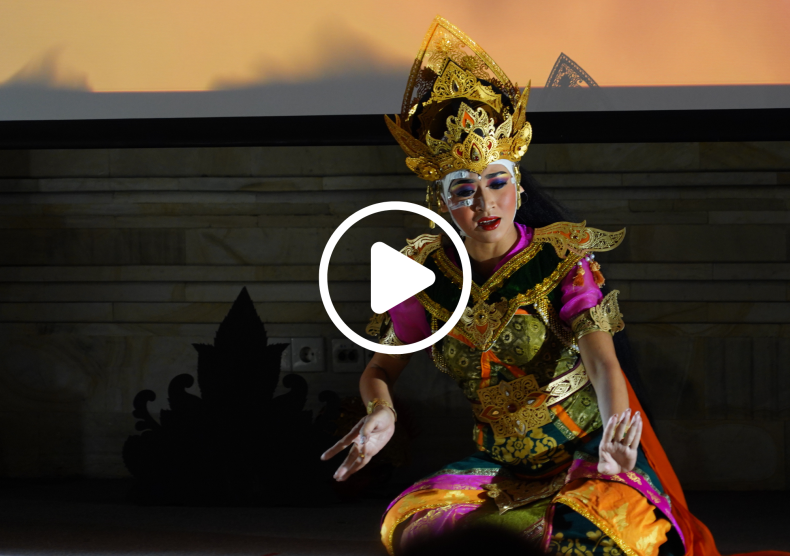
Window into the Creative Mind (2024-current)
Partners: Pianist Chelsea deSouza, multimedia artist Badie Khaleghian, the University of Houston BRAIN Center directed by Jose-Luis Contreras-Vidal, Rice University’s Vislang Lab directed by Vicente Ordonez-Roman.
The Experiment: While wearing MoBI equipment, pianist Chelsea deSouza improvised variations on classical and jazz themes she was seeing for the first time. As a control, she also performed prepared theme and variation sets by Mozart and Fazil Say.
Key Findings: The neuroengineers are studying the EEG data for neural signatures of creativity. Analysis is currently underway.
Project CHROMA (2019-current)
Partners: composer Karl Blench, Rice’s Institute for Health Resilience and Innovation directed by Christopher Fagundes, Bryan Denny, E. Lydia Wu-Chung, Melia Bonomo, Christof Karmonik, Houston Methodist’s Center for Performing Arts Medicine directed by Todd Frazier
The Experiment: Seniors with mild cognitive impairment took a six-week workshop in music composition designed by Anthony Brandt and composer Karl Blench and taught by Dr. Blench. Participants completed resting state fMRI scans pre- and post-, along with cognitive tests and wellness questionnaires. Results were compared with a control group.
Key Findings: The higher a participant’s neural flexibility at baseline, the greater their cognitive improvement in the follow-up scan. In other words, the best predictor of how much a participant would benefit from the workshop was how flexible their brain was going in. Notably, the control group did not show a significant change pre- and post-.

LiveWire (2022)
Partners: NobleMotion Dance, Musiqa, The University of Houston BRAIN Center directed by Jose-Luis Contreras-Vidal
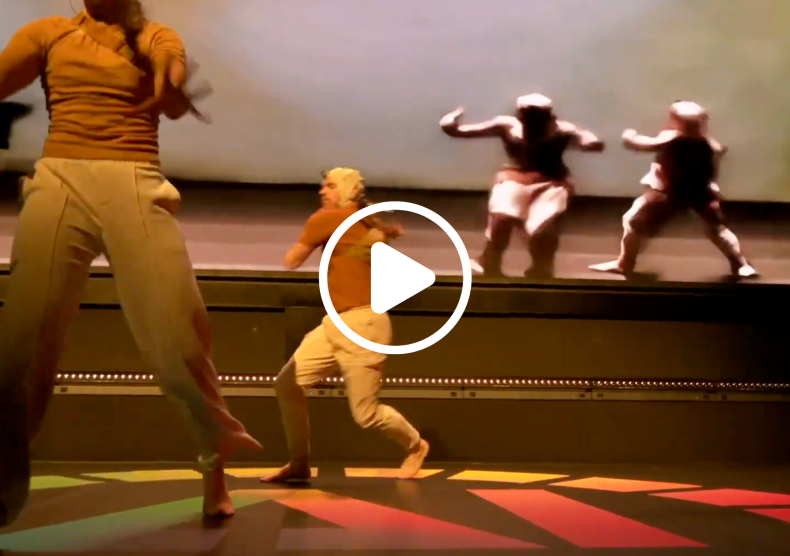
The Experiment: Two out of the nine dancers wore MoBI equipment while rehearsing and performing a dance with music by Anthony Brandt and choreography by Andy and Dionne Noble. The performance included live data visualizations.
Key Findings: The neuro-engineers were able to trace the neural consolidation that occurred as the dancers mastered the choreography.